
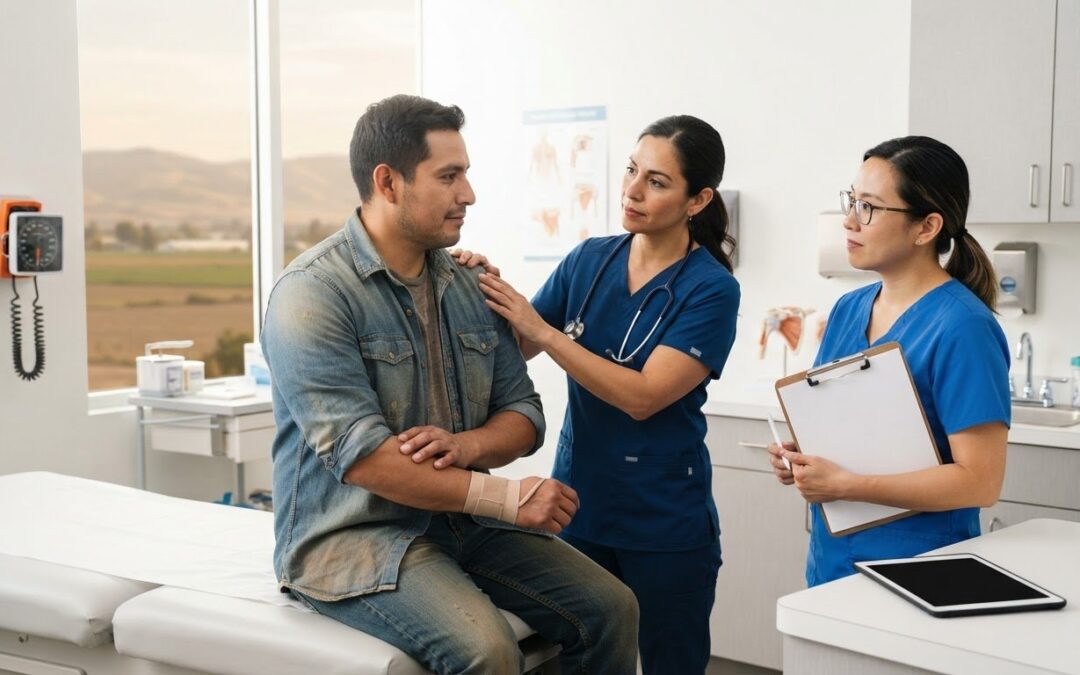
A workplace injury can leave you managing two concerns at once: getting appropriate medical care and understanding what your claim requires. Worker’s compensation evaluations help document an injury and guide decisions about treatment and returning to work. Knowing what information to bring, what the clinician will assess, and which provider your employer or insurer authorizes can make the process clearer.
This guide explains what to expect during worker’s compensation evaluations in Fresno County, how to prepare for a visit, and what to consider when choosing a provider. It also covers the role of an employer’s or insurer’s Medical Provider Network, which may affect where you can receive care.
Premium Urgent Care provides worker’s compensation evaluations and walk-in assessments for acute workplace injuries in Fresno, Clovis, and Selma. Read on for practical steps to describe your symptoms, prepare for an evaluation, and understand how medical documentation may support return-to-work planning.
Key Takeaways
- Worker’s compensation evaluations can document a work-related injury and establish a starting point for care.
- Be ready to describe the incident, your symptoms, and how the injury affects your work and everyday function.
- Before your visit, check what authorization and claim details to bring. Prepare a medication list and note relevant previous injuries.
- Urgent care may be suitable for an appropriate non-life-threatening workplace injury. Emergency symptoms need emergency care.
- When comparing local providers, check whether they assess your type of injury and whether your employer or insurer requires a particular provider or network.
Understanding Worker’s Compensation Evaluations: The First Step to Recovery
A workplace injury can affect more than your health. It may also raise questions about treatment, work duties, and claim documentation. Worker’s compensation evaluations are medical assessments of injuries believed to be work-related. The clinician examines the affected area, records relevant findings, and recommends appropriate care. That documentation can provide a baseline for tracking symptoms and recovery, but it does not decide whether an insurance claim is accepted or what benefits are payable. For background on the system’s purpose, see Workers’ compensation.
Timing matters. Report an injury to your employer promptly. California generally requires reporting within 30 days, while injuries that develop gradually may involve different considerations from a single-event accident. An early medical assessment can document symptoms and physical findings close to the time of an acute injury. For a non-life-threatening injury, Premium Urgent Care offers walk-in workplace injury assessments, including care for sprains, strains, and lacerations. A severe or life-threatening condition needs emergency care.
The Legal and Clinical Significance of the Evaluation
The evaluation is first a clinical visit focused on your health. The clinician documents your account of what happened, relevant medical history, examination findings, and any observed limits in movement or function. This information may help inform the employer’s First Report of Injury (FROI), but the employer handles that report. The clinician provides a medical assessment, not a decision about claim acceptance or benefits.
Clear records can help the people involved understand the injury, recommended care, and any temporary work limitations. Medical findings may also be considered when treatment needs or temporary disability are reviewed. A routine treatment evaluation is different from a formal medical-legal or forensic examination, which has a separate purpose and process. Describe your symptoms accurately, and ask questions if a recommendation is unclear.
Types of Workplace Injuries Evaluated at Urgent Care
Urgent care may be appropriate for certain acute, non-life-threatening workplace injuries. The assessment depends on your symptoms and the clinic’s scope of care.
- Acute trauma: Cuts and lacerations, minor burns, and wounds may need examination and care. Learn more about wound care in Fresno.
- Musculoskeletal issues: A sudden sprain or strain, or joint pain associated with repeated work tasks, can be assessed to understand your symptoms and function. For individuals exploring specialized long-term support for spine and joint pain, concierge regenerative practices like REVĪV showcase modern in-home treatment approaches.
- Skin or respiratory concerns: Describe the suspected exposure, when it occurred, and any rash, skin irritation, or breathing symptoms. The clinician can assess the concern and advise on appropriate next steps. Workers in hot environments may also develop heat rash, which requires prompt skin care and cooling to reduce irritation.
Premium Urgent Care provides worker’s compensation evaluations in Fresno, Clovis, and Selma. A medical assessment can create a clearer record and help identify appropriate care and return-to-work considerations.
The Medical Evaluation Process: What to Expect During Your Visit
Worker’s compensation evaluations combine medical care with documentation of how an injury affects your health and work function. Unlike a routine physical, which generally reviews overall health or fitness, an injury evaluation focuses on a specific workplace incident or condition, the symptoms it caused, and appropriate care. The clinician’s findings can inform claim documentation, but the clinician does not decide whether the insurer accepts the claim.
Your visit typically includes an injury history, a focused physical examination, and a written clinical assessment. Not every injury requires diagnostic testing. If X-rays, lab work, or other tests may be useful, the clinician can assess whether they are appropriate and discuss what is available or needs to be arranged. The California Division of Workers’ Compensation provides information about the state system and its role in workers’ compensation.
Step 1: Detailed Injury History and Documentation
Be ready to explain how, when, and where the injury happened, what you were doing, and when your symptoms began. The mechanism of injury is the event or motion that produced the injury, such as lifting a heavy object and feeling a sudden pull in your back. Mention previous injuries, relevant medical conditions, and current symptoms. These details help the clinician document your history and assess whether the work incident may have caused a new problem or aggravated an existing one.
Step 2: Objective Physical Assessment and Testing
The clinician examines the affected area and may assess range of motion, strength, tenderness, and how the injury affects basic function. Your description of pain matters and is considered alongside examination findings. Explain which movements hurt and which tasks you cannot comfortably perform. Do not minimize symptoms or guess at a diagnosis. Focused testing helps build a clinical picture, but a single finding is not the whole story.
At the end of the visit, the clinician records relevant findings, an assessment, and recommendations for care or follow-up. This documentation may help an employer or claims adjuster understand the medical basis for the proposed plan. Keep a copy if one is provided, and ask how to obtain the report if you need it. For non-life-threatening workplace injuries, Premium Urgent Care offers walk-in worker’s compensation assessments in Fresno, Clovis, and Selma. You can review worker’s compensation evaluation information as you consider where to seek care.
Choosing the Right Provider: Urgent Care vs. Emergency Room
The right setting depends on the seriousness of the injury, not just on where you can be seen first. Emergency rooms triage patients by medical urgency, so someone with a non-life-threatening injury may wait while more critical cases are treated. For an appropriate acute injury, an urgent care clinic with walk-in availability can be an alternative to the ER. Before you go, check whether the clinic can assess your injury and whether your employer or insurer requires you to use a particular provider or Medical Provider Network.
When Urgent Care May Be Appropriate
Urgent care may be suitable for some non-life-threatening injuries, such as a minor laceration or sprain, when the clinic offers the care needed. Premium Urgent Care provides worker’s compensation evaluations and acute injury care, including suturing lacerations. A work-related respiratory concern also warrants medical attention. For general information about symptoms and treatment, see this guide to upper respiratory infections.
Costs and claim handling depend on the circumstances, insurance arrangements, and care required. Choosing an appropriate setting may help avoid using an ER for an injury that does not need emergency-level attention, but it does not guarantee lower claim costs. Ask the clinic how it documents the visit and what claim information you should provide. Do not assume the provider has established communication with your employer or insurance carrier. Confirm who is responsible for submitting records and reports.
For an ongoing injury, continuity may also matter. Ask whether the clinic can accommodate a follow-up assessment if one is recommended, and how to obtain your medical documentation. Premium Urgent Care serves Fresno, Clovis, and Selma, offering injured workers in those communities a local option to consider. Its walk-in availability is intended for workplace injury assessment, but confirm current arrangements and claim requirements before visiting. In some cases, the employer’s or insurer’s Medical Provider Network may affect where you can receive care.
When to Go to the Emergency Room
Seek emergency care for symptoms that may signal a serious or life-threatening condition. Examples include loss of consciousness, severe bleeding, or chest pain. These situations need emergency assessment, not a routine urgent care visit. If you are unsure whether symptoms are an emergency, seek immediate medical guidance rather than delaying care to sort out claim paperwork.
Urgent care has limits. A clinic may determine that an injury needs a higher level of care and direct you to an emergency department, but it is not a substitute for hospital emergency services or major treatment. Prioritize safety first. Claim documentation and follow-up arrangements can be addressed once urgent medical needs are managed.
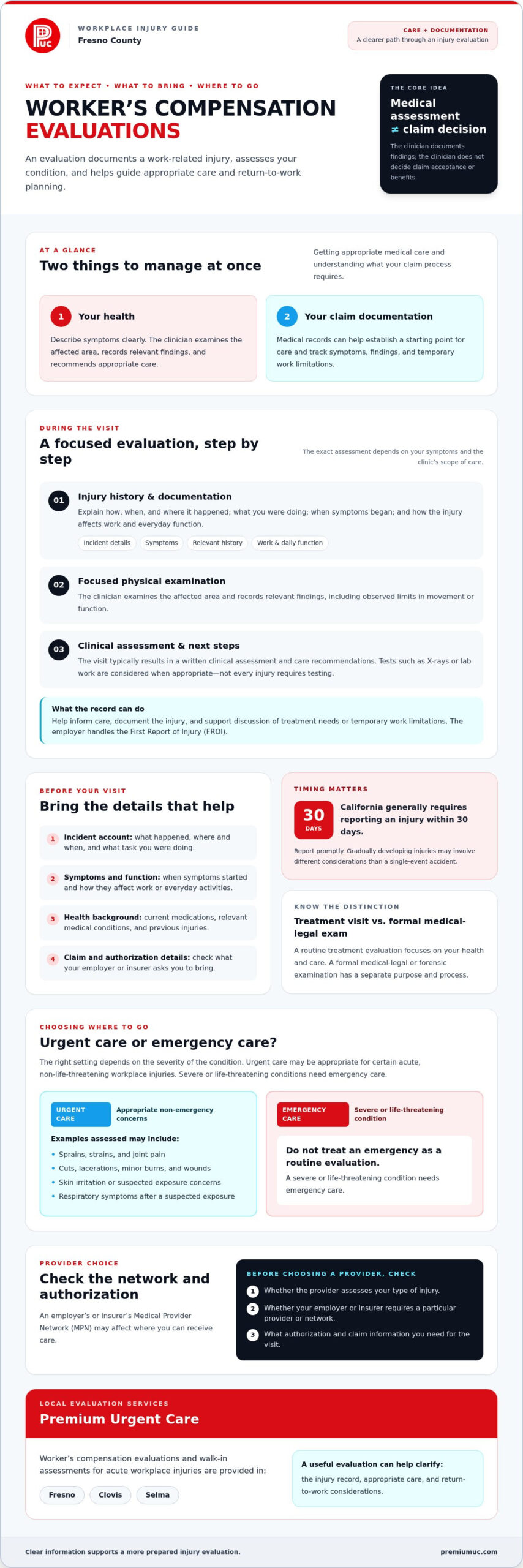
Preparation Checklist: Ensuring a Smooth Worker’s Comp Claim
A little preparation can make worker’s compensation evaluations more focused and help the clinician document your condition clearly. Before your appointment, confirm with your employer or claims contact which clinic you are authorized to visit and what paperwork is required. Requirements vary, so do not assume that the same form or insurance arrangement applies to every claim.
Essential Documentation for Your Appointment
Gather claim details and relevant records before you leave. If your employer or insurer has provided an authorization-to-treat form, bring it or ask whether the clinic needs it in advance. Have insurance carrier information and any assigned claim number available. A government-issued photo ID is useful. Contact the clinic to confirm its identification and documentation requirements.
- Work and claim details: Employer contact information, the date and location of the incident, and a claim number if one has been assigned.
- Medical information: A current medication list, relevant health conditions, previous injuries to the affected area, and any records you have been asked to bring.
- Symptom notes: When symptoms began, what makes them better or worse, and which movements or work tasks are difficult.
Specific examples are more useful than general descriptions. Instead of saying only, “My shoulder hurts,” note whether reaching overhead, carrying a tool, or repeating a motion increases the discomfort. Describe what you can and cannot do without estimating or exaggerating. If symptoms change during the day, note when that happens.
Clinical Communication: Be Clear About Your Work
Explain your regular duties, including lifting, standing, driving, computer work, or repetitive movements. If you also need a work physical, ask how that examination differs from an injury evaluation and tell the clinician which job requirements it relates to. A work physical assesses fitness for specified duties. An injury evaluation focuses on symptoms and findings related to a reported workplace injury. Neither takes the place of the other.
Before the visit ends, ask practical questions: What activities should I limit? Are temporary work restrictions recommended? What follow-up or additional testing may be needed? When should I seek care again if symptoms change? Write down the answers so you can share them accurately with your employer or claims contact.
Be candid about pain, previous injuries, and functional limits. Accurate information helps the clinician document your condition fairly and, if relevant later, assess maximum medical improvement (MMI) without understating or overstating your symptoms. An initial evaluation does not necessarily determine MMI. Ask the clinician to explain any status or terminology in your report.
Premium Urgent Care provides worker’s compensation evaluations in Fresno, Clovis, and Selma. Review worker’s compensation evaluation options and confirm what to bring before your visit.
Worker’s Compensation Evaluations at Premium Urgent Care
When choosing a local provider for a workplace injury, consider whether the clinic can assess the type of injury, how you can access care, and what documentation you may need. Led by Medical Director Dr. Erick Green, the clinic offers walk-in assessments for acute workplace injuries.
An evaluation is more than a form for an insurance file. It gives a clinician the opportunity to assess the injury, document relevant findings, and identify appropriate next steps. Medical reports should reflect the patient’s history and examination, not assumptions about what an employer or claims adjuster wants to see. If you need a specific form or claim document completed, ask the clinic and your employer or claims contact what is required.
Care for Workplace Injuries and Physicals
Premium Urgent Care offers worker’s compensation care, work physicals, and sports physicals, along with treatment for several types of acute injuries. Depending on the injury and clinical assessment, care may include evaluation of sprains and strains or suturing for a laceration. A minor burn may also be assessed as an urgent care concern. The appropriate care depends on the individual case and the clinic’s ability to address it.
Work physicals and injury evaluations serve different purposes. A physical relates to work fitness requirements, while an injury evaluation addresses a specific reported condition. If you are unsure which service your employer requested, confirm the purpose of the visit before arriving and bring any instructions or forms you have received.
Local, Organized Support
For workers in Fresno, Clovis, and Selma, Premium Urgent Care is a local option to consider for non-life-threatening workplace injuries. Walk-in availability can be useful when an acute injury needs assessment, but confirm current clinic arrangements and employer or insurer requirements before visiting. In some cases, the employer’s or insurer’s Medical Provider Network may affect where you can receive care.
Clear communication supports a more useful medical record. Be ready to explain how the injury happened, what symptoms you are experiencing, and which job tasks are affected. Ask how to obtain your visit documentation and what follow-up the clinician recommends. The clinic’s role is to assess and document medical findings. Claim decisions remain with the appropriate parties.
For injured workers and employers considering worker’s compensation evaluations, Premium Urgent Care offers a local point of care and acute injury assessment in Fresno, Clovis, and Selma. Confirm authorization, claim paperwork, and any network requirements before your visit so the evaluation can focus on your health and the information needed for your claim.
Take the Next Step Toward Clearer Injury Care
A well-documented medical assessment can clarify the nature of a workplace injury, recommended care, and any work limitations. Prepare by gathering claim information, noting your symptoms, and checking whether your employer or insurer requires a specific provider or network. Choose care based on the injury’s urgency: emergency symptoms need an emergency department, while urgent care may be suitable for an appropriate non-life-threatening injury.
Premium Urgent Care provides worker’s compensation evaluations and walk-in assessments for acute workplace injuries in Fresno, Clovis, and Selma. The clinic offers evaluation and care for injuries including sprains, strains, and lacerations. Confirm authorization and visit requirements with your employer or claims contact before you go.
Frequently Asked Questions
How long does a worker’s compensation evaluation typically take?
There is no fixed visit length. The time depends on the injury, medical history, examination, and whether diagnostic testing is needed. A straightforward assessment may take a different amount of time than a visit involving a wound or additional evaluation. Allow time to explain how the injury happened and discuss the care plan. If you are visiting Premium Urgent Care in Fresno, Clovis, or Selma, contact the clinic to ask about current wait times and visit expectations.
Do I need an appointment for a worker’s comp visit at Premium Urgent Care?
Premium Urgent Care offers walk-in availability for workplace injury assessments, so an appointment may not be necessary. Before heading to a Fresno, Clovis, or Selma location, confirm current arrangements and ask what claim authorization or paperwork to bring. Your employer or insurer may also direct you to a particular provider or Medical Provider Network. If the injury is severe or life-threatening, seek emergency care rather than waiting for an urgent care visit.
What should I bring to my first worker’s compensation medical appointment?
Bring a photo ID, any employer or insurer authorization you have received, and claim details such as the carrier’s contact information and assigned claim number. Also prepare a current medication list, relevant medical history, and details of previous injuries to the affected area. Note when the injury happened, what you were doing, and which movements or work tasks worsen your symptoms. Check with the clinic or employer about any additional required documents.
Can I choose my own doctor for a worker’s comp evaluation in California?
Your choice of provider may depend on the claim and the employer’s or insurer’s Medical Provider Network (MPN). In many cases, workers must receive care within the applicable network after the first visit, so do not assume you can select any clinic. Ask your employer or claims administrator which rules apply, whether Premium Urgent Care is an authorized option, and what steps to take before arranging an evaluation.
What happens if the evaluation determines my injury is not work-related?
A clinician documents medical findings and may discuss whether they appear consistent with the history you provided, but the evaluation alone does not decide whether your claim is accepted. The employer or insurance carrier handles the claim decision. Ask how to obtain your visit documentation and share relevant information with your claims contact. If you disagree with a claim decision, ask the claims administrator about next steps or seek guidance from an appropriate workers’ compensation resource.
Will I receive a return-to-work note on the same day as my evaluation?
A same-day note is not guaranteed. The clinician’s recommendations depend on the examination and the information available during your visit. If medically appropriate, you may receive documentation describing work restrictions or whether further assessment is needed. Explain your actual job duties, such as lifting, standing, or repetitive movements, and ask what documentation will be provided and how to obtain it before leaving the clinic.
Does Premium Urgent Care handle follow-up visits for workplace injuries?
Premium Urgent Care provides worker’s compensation evaluations and acute injury assessments, but follow-up arrangements depend on your needs and claim requirements. Ask the clinic whether it can provide the recommended follow-up for your specific injury, and confirm whether your employer or insurer requires care within a Medical Provider Network. Keep your visit paperwork and follow the clinician’s instructions. For worsening or emergency symptoms, seek appropriate medical attention promptly.
What is the difference between a work physical and a worker’s comp evaluation?
A work physical assesses health or fitness in relation to specified job requirements. A worker’s compensation evaluation focuses on an injury reported as work-related, including its history, symptoms, examination findings, and appropriate care recommendations. Premium Urgent Care offers both work physicals and workplace injury evaluations. Tell the clinic which service your employer requested, and bring any instructions or forms so the visit addresses the right purpose.
Contact Premium Urgent Care about a worker’s compensation evaluation in Fresno, Clovis, or Selma.