
Searching for a Selma medical clinic? First confirm that the result serves Selma, California, rather than another community with the same name. Then consider whether the clinic offers the level of care your concern needs. For a new illness or minor injury, knowing what urgent care can evaluate helps you choose where to start.
Premium Urgent Care serves Selma, California, with walk-in consultations for acute, non-emergency concerns. The clinic evaluates respiratory symptoms, ear or urinary concerns, minor injuries, and wounds, among other issues. This guide explains what may fit an urgent care visit, how to prepare, and when emergency services or ongoing primary care are more appropriate.
Before a visit, make a note of when your symptoms began, gather relevant health information, and bring identification and medication details. These practical steps can help you describe your concern clearly. The guidance below also explains how to distinguish local Selma, California, care from similarly named results elsewhere.
Key Takeaways
- Confirm that a Selma medical clinic serves Selma, California. Premium Urgent Care serves Selma, Clovis, and Fresno.
- Urgent care can evaluate many acute illnesses, infections, minor injuries, and work-related concerns.
- Choose between urgent care, primary care, and emergency care based on whether your concern is new, ongoing, or potentially life-threatening.
- For a walk-in visit, note your symptoms, gather relevant records, and bring identification and medication details.
- Premium Urgent Care provides non-emergency care. Seek emergency services for a potentially life-threatening concern.
Searching for a Selma Medical Clinic? Start with the Right Selma
A search for a Selma medical clinic may return providers in different states. Check the city and state in a clinic’s location information rather than relying on the name alone. Premium Urgent Care serves patients in Selma, Clovis, and Fresno, California, with walk-in consultations for acute, non-emergency illnesses, infections, and minor injuries.
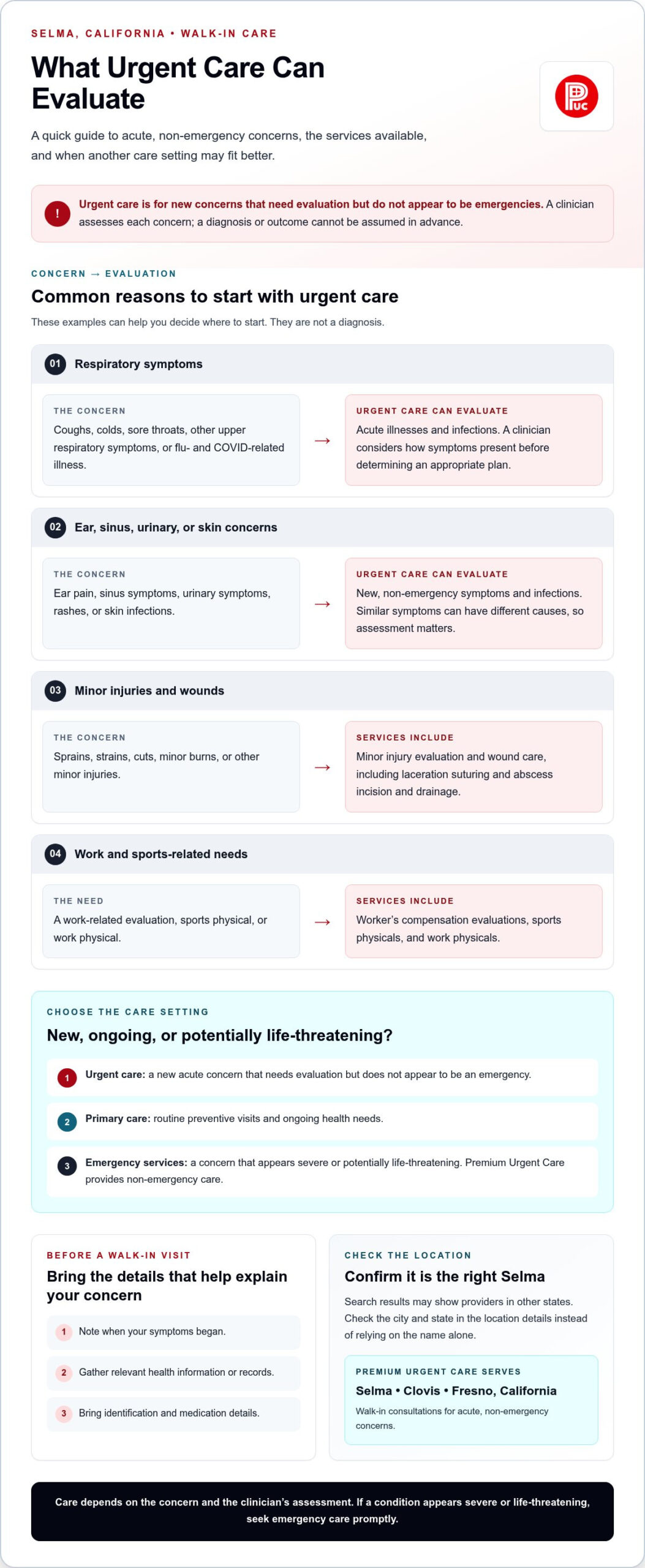
Next, match the care setting to your need. Urgent care is for a new concern that needs evaluation but does not appear to be an emergency. Primary care is generally a better fit for routine preventive visits and ongoing health needs. If symptoms suggest a medical emergency, seek emergency care instead of going to a walk-in clinic.
How to distinguish Selma, California care from similarly named results
Location details are more useful than a familiar clinic name. For example, some search results for Selma Medical Associates describe care in the Northern Shenandoah Valley around Winchester, Virginia. That is a different service area from Selma, California. Check the city and state listed for a provider to see whether the result is relevant to your location.
Premium Urgent Care serves Selma, Clovis, and Fresno in California. This helps distinguish its local acute care from similarly named results elsewhere. It is a more reliable way to identify a nearby option than assuming a result serves your community because it includes the word “Selma.”
When a walk-in urgent care clinic may fit
Urgent care may be appropriate for a new, non-emergency concern such as cough or cold symptoms, urinary symptoms, ear pain, or a minor injury like a sprain. Premium Urgent Care provides walk-in consultations and evaluates acute illnesses, infections, and minor injuries. A clinician assesses the concern and determines an appropriate course of care. A specific diagnosis or outcome cannot be assumed in advance.
An overview of urgent care centers describes their role in treating conditions that need attention but are not life-threatening emergencies. This distinction can help when deciding between urgent care and a scheduled primary-care visit. For an ongoing issue or routine health management, a primary-care provider is generally the more appropriate point of contact. If a condition appears severe or life-threatening, seek emergency care promptly.
As a practical guide, consider urgent care for an acute concern that needs medical evaluation but does not appear to be an emergency. Use primary care for routine or continuing needs, and emergency services for emergencies. The next sections cover common concerns an urgent care clinic can evaluate and ways to prepare for a walk-in visit.
What a Selma Urgent Care Clinic Can Treat
A Selma medical clinic offering urgent care can evaluate new, non-emergency health concerns. Premium Urgent Care provides walk-in consultations for acute illnesses, infections, and minor injuries, as well as worker’s compensation evaluations and physicals. The right care depends on your symptoms and the clinician’s assessment. The examples below can help you decide where to start, but they are not a diagnosis.
Illnesses and infection symptoms evaluated at urgent care
Common reasons to seek an urgent care evaluation include coughs, colds, sore throats, and other upper respiratory symptoms, as well as flu- or COVID-related illness. The clinic also evaluates ear pain, sinus symptoms, urinary symptoms, rashes, and skin infections. For a general explanation, HealthCare.gov provides a definition of urgent care as care for health issues that need prompt attention but are not emergencies.
Similar symptoms can have different causes and may call for different care. A clinician considers how the symptoms present before determining an appropriate plan. For more background on respiratory concerns, see this upper respiratory infection treatment guide. The guide offers general information; an individual visit allows a clinician to assess the patient’s specific symptoms.
Minor injuries, wound care, and workplace evaluations
Urgent care may also be suitable for certain minor injuries, including sprains, strains, cuts, and minor burns. Premium Urgent Care provides wound care, including laceration suturing, as well as abscess incision and drainage. The appropriate approach depends on the injury or skin concern and the clinician’s evaluation. The wound care guide for Fresno provides additional context about minor wounds and urgent care.
Patients may also visit for work-related needs. Premium Urgent Care offers worker’s compensation evaluations, sports physicals, and work physicals. These services are different from treatment for a new injury or illness, although a workplace concern may involve both an evaluation and an acute health issue. Explain what happened and what symptoms followed so the clinician can understand the concern. A particular diagnosis or outcome cannot be assumed in advance.
Urgent care can address a range of acute concerns, from respiratory symptoms and urinary complaints to minor wounds and sprains. For walk-in urgent care consultations for a non-emergency concern, Premium Urgent Care serves patients in Selma, Clovis, and Fresno, California.
Urgent Care, Primary Care, or Emergency Care in Selma?
An unexpected health concern does not always call for an emergency department visit. Consider how serious it is, whether it is new or ongoing, and how quickly it needs attention. This comparison can help you choose where to start, but it is not a substitute for medical advice.
| Care setting | Purpose and typical need | Level of urgency |
|---|---|---|
| Urgent care | Evaluation of acute, non-emergency concerns and minor injuries | Prompt attention, but not a life-threatening emergency |
| Primary care | Routine health needs, ongoing concerns, and chronic disease management | Planned or continuing care |
| Emergency department | Potentially life-threatening or severe medical emergencies | Immediate emergency care |
Premium Urgent Care evaluates acute, non-emergency concerns through walk-in consultations. Its role differs from that of an emergency department, and it does not provide 24/7 emergency care. The CMS Place of Service Codes reference explains how healthcare settings are categorized for administrative purposes. Those codes do not determine what level of care an individual’s symptoms require.
How urgent care differs from primary care
Urgent care focuses on new, acute concerns, such as a recently developed illness or a minor injury that needs evaluation. Primary care is generally intended for routine checkups, ongoing health needs, and continued management of chronic conditions. A visit to a Selma medical clinic for an urgent concern does not replace establishing ongoing care with a primary-care clinician.
The main distinction is immediate need versus continuity of care. If a concern is new and non-emergency, urgent care may be a suitable place to start. For follow-up over time or support managing a continuing condition, primary care is usually the more appropriate setting.
When emergency care is the safer choice
Some health problems may be life-threatening or worsen rapidly. If you believe you or someone else is experiencing a medical emergency, call 911 or go to an emergency department. Do not delay emergency care to visit an urgent care clinic. If you are unsure how serious the situation is, err on the side of seeking emergency help.
Urgent care is not a substitute for emergency services, and Premium Urgent Care is not a 24/7 emergency service. Use it for concerns that need clinical evaluation but do not appear to be emergencies. If the issue is severe, potentially life-threatening, or rapidly worsening, choose emergency care instead.
How to Prepare for a Walk-In Clinic Visit Near Selma
A little preparation can make it easier to explain your concern and help the clinician understand what brought you in. Before visiting a Selma medical clinic for an acute issue, gather key details about your symptoms, relevant health history, and current medications. You do not need to have every answer. A brief, clear account is useful.
What information can help the clinician evaluate you
Start with a simple timeline. Note when the symptoms began, how they have changed, and what seems to affect them. For an injury, include how it happened and which area is affected. If you are concerned about a possible exposure, share relevant details. Making a few notes can help you describe the situation accurately, especially if you feel unwell or distracted.
Bring or write down:
- Your current medications, including names and doses if known
- Any relevant allergies, including medication allergies
- Important medical history related to the current concern
- Relevant records you already have, such as prior instructions about the same issue
Be ready to mention any changes since the concern began, such as a new symptom or a worsening injury. Share information openly during the evaluation. You do not need to self-diagnose. Describing what you have noticed is more helpful than trying to determine the cause on your own.
Practical steps before traveling from Selma
Before setting out, review the clinic’s current location-specific operating information so you can plan your visit. Use current details rather than assuming a location’s hours or arrangements. Bring identification and, if applicable, your insurance information. Having insurance details with you does not establish coverage, but it means the relevant information is available.
Use this short preparation sequence:
- Write down when the concern started and how it has changed.
- Gather relevant medical records, medication details, and allergy information.
- Bring identification and insurance information if applicable.
- Review current local operating information before traveling.
If you are visiting because of a workplace injury, be prepared to explain what happened and when. Bring any relevant information you already have about the incident, without assuming that a particular document is required. The clinician will evaluate your concern based on the information you share and your presentation.
For current local information before your visit, review Premium Urgent Care’s location details. Preparation can support a clearer conversation, but it cannot replace an emergency response. If you think the situation may be life-threatening, call 911 or go to an emergency department.
Premium Urgent Care: Local Next Steps for Selma Patients
Choosing a clinic starts with matching your concern to the care it provides. Premium Urgent Care serves Selma, Clovis, and Fresno, California, with walk-in consultations for acute, non-emergency illnesses, infections, and minor injuries. It offers local patients evaluation when a new concern needs attention but does not appear to be a medical emergency.
Care for acute concerns across Selma, Clovis, and Fresno
Patients may seek evaluation for cough and cold symptoms, sore throats, ear or sinus complaints, urinary symptoms, and flu- or COVID-related illness. The clinic also evaluates minor injuries and wound concerns, including sprains, cuts, and lacerations. Outpatient procedures include laceration suturing and abscess incision and drainage. The appropriate care depends on the patient’s symptoms and the clinician’s assessment, so an example cannot guarantee a particular diagnosis or treatment.
Other services include worker’s compensation evaluations and sports and work physicals. These address different needs from an acute illness or injury, but they are also part of the care available to patients in the communities served. When searching for a Selma medical clinic, identifying whether you need help with a new health concern, a physical, or an emergency can clarify your next step.
- New illness or infection symptoms: Seek evaluation for acute respiratory, urinary, ear, sinus, or other infection concerns.
- Minor injury or wound: A clinician can assess concerns such as sprains, cuts, and lacerations.
- Work or sports-related need: Worker’s compensation evaluations and physicals are available as separate service categories.
Find the right next step for your health concern
If you have a non-emergency concern, use Premium Urgent Care’s current information for local patients to plan a visit. Check the location-specific details for the area you intend to visit. The clinic serves Selma, Clovis, and Fresno, California, and current local information can help you plan accordingly.
View Premium Urgent Care’s current local information to learn more about walk-in consultations and the acute concerns the clinic evaluates. This can help you decide whether an urgent-care visit fits your situation. For ongoing health needs, continue with appropriate primary care. Premium Urgent Care is not a substitute for emergency services or ongoing chronic disease management.
Pay attention to changes in your condition. If you believe symptoms may be life-threatening, call 911 or go to an emergency department rather than delaying care to visit urgent care.
Make Your Next Care Decision with Confidence
A search can point you toward options, but the next step is choosing care that fits your concern. Consider whether the issue is acute, whether it appears to be an emergency, and whether it needs ongoing attention. This makes a search for a Selma medical clinic more useful than relying on a name alone.
For a non-emergency concern, use Premium Urgent Care’s current information for local patients to plan your visit. View Premium Urgent Care information for local patients and use those details to guide your next step. If symptoms may be life-threatening, call 911 or go to an emergency department instead of delaying care for an urgent-care visit.
Health concerns can feel uncertain, but choosing care based on urgency and purpose is a practical place to begin. Take the next step that fits your situation, and seek emergency help promptly if the concern is potentially life-threatening.
Frequently Asked Questions
Is Premium Urgent Care the same as Selma Medical Associates?
No. Selma Medical Associates is described as serving the Northern Shenandoah Valley, with a facility in Winchester, Virginia. Premium Urgent Care serves Clovis, Selma, and Fresno, California. Similar names can make search results confusing, so compare the stated service area and type of care before deciding where to seek help. A clinic’s name alone does not show whether it serves your community or fits your health concern.
Can I walk in to Premium Urgent Care for an acute concern?
Yes. Premium Urgent Care provides walk-in consultations for acute concerns, including common illnesses, infections, and minor injuries. Before arriving, review current location-specific information and note when the concern began, any changes, and medications you take. These details can support the clinician’s evaluation, but they cannot establish a diagnosis or guarantee a particular treatment. If the situation may be life-threatening, call 911 rather than traveling to urgent care.
What should I bring to an urgent care visit in Selma?
Bring identification, insurance information if applicable, and a current medication list. Include relevant allergies and medical history, especially details connected to the concern you want evaluated. A brief note about when symptoms began and how they have changed can help you give a clear account during the visit. These items support the clinical conversation, but they do not determine coverage or what tests, diagnosis, or treatment may be appropriate.
Can urgent care evaluate a workplace injury?
Yes. Premium Urgent Care offers worker’s compensation evaluations. Be prepared to explain when and how the injury occurred, which body area is affected, and what symptoms you have noticed since. Employer reporting procedures or claim requirements may be separate from a medical evaluation, so do not assume a clinic visit completes workplace paperwork or reporting obligations. Share relevant information with the clinician so they can assess your situation.
Can urgent care treat a minor burn?
Premium Urgent Care evaluates minor burns. The appropriate care depends on factors such as the burn’s location, size, depth, and symptoms, which cannot be assessed reliably through an FAQ. Do not rely on an online description to determine severity or treatment. If the injury appears severe or potentially life-threatening, seek emergency help. For a non-emergency burn, a clinician’s assessment can guide care based on how it presents.
What should I do if my symptoms become an emergency while I am seeking care?
Call 911 or go to an emergency department if symptoms seem potentially life-threatening. Premium Urgent Care provides walk-in urgent care, not 24/7 emergency services, so do not delay emergency care to travel to the clinic. If immediate danger may be present and you are uncertain, use emergency services. Prioritize getting emergency help rather than continuing with plans for a non-emergency evaluation.
Does a walk-in urgent care visit replace a primary-care relationship?
No. A walk-in visit addresses an acute, non-emergency concern; it is not a substitute for ongoing primary care or chronic disease management. A primary-care clinician can help coordinate continuing health needs over time. If you are managing a long-term condition, follow your established care plan and direct questions about ongoing management to your regular clinician. For a new, separate concern, a Selma medical clinic offering urgent care may provide an evaluation.