

Could choosing where to seek care start with a more important question than “Which one is faster?” The urgent care vs emergency room decision should begin with immediate risk. Symptoms that may be life-threatening call for emergency care, while many non-emergency illnesses and minor injuries can be evaluated at urgent care.
It’s understandable to hesitate. You may want to avoid an unnecessary trip to the ER, but you also don’t want to delay care when every minute matters. Call 911 for severe symptoms such as chest pain, trouble breathing, signs of a stroke, loss of consciousness, or heavy bleeding.
This guide explains how emergency rooms and urgent care differ, which warning signs need emergency attention, and what walk-in care can address. Premium Urgent Care provides evaluations for acute, non-emergency concerns in Clovis, Selma, and Fresno, including respiratory illnesses, urinary symptoms, sprains, and cuts that may need stitches. Use the guidance below to choose a next step based on the symptoms and level of care needed.
Key Takeaways
- In the urgent care vs emergency room decision, start with immediate risk and symptom severity, not convenience alone.
- Severe trouble breathing, suspected stroke, severe chest pain, uncontrolled bleeding, and loss of consciousness are reasons to seek emergency help.
- Urgent care and emergency departments serve different needs. Wait times can vary with demand and patient needs.
- Use a simple decision process: check for immediate danger, assess symptom severity, then choose the appropriate care setting without relying on self-diagnosis.
- For appropriate acute, non-emergency concerns, Premium Urgent Care provides walk-in evaluations for patients in Clovis, Selma, and Fresno.
Urgent Care vs. Emergency Room: What Is the Difference?
Urgent care evaluates acute, non-emergency illnesses and minor injuries that need attention but don’t appear to pose an immediate threat to life. An emergency department evaluates and treats emergencies, including potentially life-threatening or rapidly worsening conditions. The right choice depends on the symptoms, their severity, and the risk of delay, not simply which setting seems more convenient.
Symptoms don’t always fit neatly into one category. A problem that seems manageable can become more serious, and the same symptom may carry different risks for different people. If you’re uncertain, seek prompt professional guidance. If the situation appears immediately serious, call 911 rather than trying to determine whether urgent care can handle it.
What urgent care is designed to address
Urgent care provides walk-in evaluation for new concerns that need timely attention but aren’t emergencies. Examples include cough and other respiratory symptoms, urinary symptoms, a sprain, or a minor cut. The Urgent care center overview describes this type of clinic and its general distinction from emergency departments.
The appropriate evaluation and treatment depend on the person’s symptoms and individual needs. If an assessment suggests a condition requires emergency-level care, urgent care isn’t a substitute for that higher level of evaluation. Likewise, specialized health needs such as oral rehabilitation and restorative tooth care fall outside walk-in medical clinics and are best directed to dedicated practices such as Star Dental Care.
What makes an emergency department different
An emergency department provides hospital-based care for emergencies, including symptoms that may signal a serious or rapidly worsening condition. Its role is to assess urgent risks and provide emergency treatment as needed. The next steps depend on the clinical assessment, and no care setting can guarantee an outcome.
Call 911 for an immediate, serious emergency, especially if the person may be in danger and needs emergency assistance. Don’t delay by visiting an urgent care clinic first. Emergency evaluation and hospital-based treatment are distinct from routine walk-in care.
For the urgent care vs emergency room decision, consider both the symptom and how severe it feels or whether it is getting worse. A mild, stable concern may be appropriate for urgent care; a severe or rapidly worsening problem may need emergency assessment. These are general distinctions, not a diagnosis.
- Consider urgent care: The concern is acute but appears non-emergency, such as a minor injury or common illness.
- Seek emergency care: Symptoms are severe, rapidly worsening, or could indicate immediate danger.
- When unsure: Get prompt professional guidance rather than relying on a label or waiting for symptoms to become clearer.
Convenience matters only after safety. Urgent care does not replace 911, emergency evaluation, or hospital-based treatment. When the level of risk is unclear, seek timely professional assessment, particularly if symptoms worsen or new concerning signs appear.
Which Symptoms Need an Emergency Room or 911?
Some symptoms can signal a medical emergency and need immediate assessment. This list is not exhaustive and can’t diagnose the cause of a symptom. If a person appears to be in immediate danger, call 911. Don’t delay by visiting urgent care first.
- Severe trouble breathing or sudden difficulty breathing.
- Severe chest pain or pressure, especially if it feels intense or is getting worse.
- Possible stroke signs, such as sudden facial drooping, weakness on one side, or difficulty speaking.
- Uncontrolled bleeding that is heavy or won’t stop.
- Loss of consciousness, sudden confusion, or a seizure.
- A serious injury, particularly when symptoms are severe or the person’s condition is worsening.
These are warning signs, not a checklist you need to complete before acting. One concerning symptom may be enough to seek emergency help. Sudden, severe, or rapidly worsening symptoms deserve attention even if they aren’t named here.
Warning signs that should not wait for urgent care
Emergency care is the safer next step when a person may be at immediate risk. Call 911 for severe breathing difficulty, suspected stroke symptoms, severe chest pain, uncontrolled bleeding, loss of consciousness, a seizure, sudden confusion, or a serious injury. If getting to care by car could put the person or others at risk, don’t drive. Follow the dispatcher’s instructions.
Time matters when symptoms are severe or changing quickly. Don’t wait to see whether they settle, and don’t try to rule out a serious condition at home. If someone is unconscious or confused, they may be unable to explain what they’re experiencing, so treat the situation with particular caution.
When the right setting is unclear
Let the level of risk guide your next move. If symptoms are severe, rapidly worsening, or potentially life-threatening, prioritize emergency services and call 911 when there may be immediate danger. Don’t choose urgent care solely because it seems more convenient.
If the concern is uncertain but not severe, seek timely guidance from a qualified medical professional. Be ready to describe when symptoms began, how they have changed, and what the person is experiencing. This information can help guide the next step, but it doesn’t replace clinical assessment. If the condition worsens while you’re seeking guidance, take that change seriously and seek emergency help.
The urgent care vs emergency room decision can’t be made reliably from a symptom list alone. For an acute concern that appears non-emergency, Premium Urgent Care provides walk-in evaluations for illnesses and minor injuries, including respiratory symptoms, urinary symptoms, sprains, and lacerations. For a concern that fits this level of care, learn about Premium Urgent Care. If emergency warning signs are present, call 911 instead.
Urgent Care vs. ER: Comparing Care and Timing
The urgent care vs emergency room choice comes down to the level of assessment a health concern may require. Urgent care focuses on acute, non-emergency concerns. An emergency department evaluates potentially serious conditions and can connect patients with hospital-based resources. Neither setting guarantees a particular wait or outcome; the appropriate choice depends on the person’s symptoms and clinical needs.
| Comparison | Urgent care | Emergency department |
|---|---|---|
| Purpose | Evaluate acute concerns that appear non-emergency. | Assess and treat emergencies, including potentially life-threatening conditions. |
| Typical concern | A new illness or minor injury that needs timely attention. | A serious, severe, or rapidly worsening condition that may need emergency-level care. |
| Emergency capability | Provides outpatient evaluation and care for appropriate concerns. Services vary among clinics. | Hospital-based emergency assessment with access to hospital resources as clinically needed. |
How the two settings differ in purpose and scope
The distinction is not simply that one setting is faster or easier to reach. Urgent care is intended for concerns that need prompt evaluation but don’t appear to require emergency care. Emergency departments assess more serious risks and can coordinate hospital-based treatment when indicated. Resources and services vary by facility, so don’t assume every urgent care center offers a particular test or procedure; for instance, specialized acute needs such as dental emergencies typically require care from dedicated clinics like 7 Pearls Dental instead of a standard walk-in center.
For example, a minor injury may be suitable for outpatient evaluation, while a serious injury or severe symptoms may call for emergency assessment. The symptoms and the person’s condition guide that decision. If warning signs suggest immediate danger, choose emergency help rather than comparing convenience.
Why a quick visit or lower bill is not guaranteed
Waits vary by location, time, patient acuity, and demand. At an emergency department, patients with more urgent conditions may need attention first, so arrival time alone doesn’t determine how quickly someone is seen. Urgent care may be a practical option for appropriate non-emergency concerns, but a shorter wait isn’t guaranteed.
Costs also depend on the insurance plan, facility, and care provided. Coverage and patient responsibility can differ, so review your plan benefits for routine cost questions. Don’t delay emergency care to compare bills or confirm coverage if symptoms suggest immediate danger.
Convenience and cost are secondary to safety. If symptoms are severe, rapidly worsening, or potentially life-threatening, seek emergency care or call 911. For a stable concern that appears non-emergency, urgent care may offer an appropriate outpatient evaluation. If the level of care remains unclear, seek timely professional guidance rather than relying on expected wait times or cost alone.
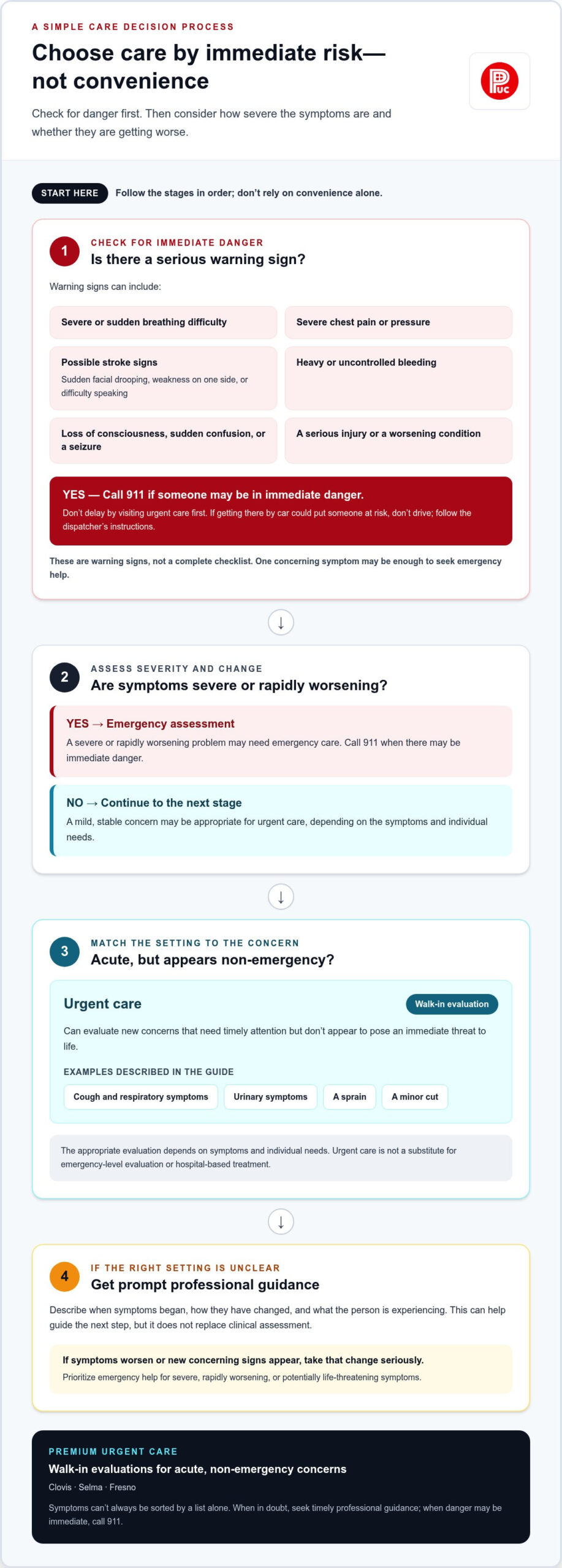
How to Decide Where to Go: A Step-by-Step Guide
A clear sequence can help you choose a next step without trying to diagnose the cause yourself. Use these steps as general guidance, not as a substitute for clinical assessment. If symptoms change or become more severe, reassess the situation instead of relying on an earlier decision.
A quick safety-first decision sequence
- Check for immediate danger. Look for severe, sudden, or potentially life-threatening symptoms, such as serious difficulty breathing, suspected stroke signs, severe chest pain, uncontrolled bleeding, or loss of consciousness. Call 911 if the person may be in immediate danger. Don’t drive yourself or someone else if doing so would be unsafe.
- Consider the concern’s severity. If there are no emergency warning signs, consider whether the problem is acute and needs prompt attention but appears non-emergency. New respiratory symptoms, urinary symptoms, a minor sprain, or a small cut may be appropriate for urgent care evaluation, depending on the person’s condition.
- Seek professional evaluation and watch for change. Choose a suitable care setting based on the symptoms and their severity. If the condition worsens, new concerning symptoms develop, or you’re unsure whether it’s an emergency, seek timely medical guidance. Escalate to emergency care if serious warning signs appear.
The urgent care vs emergency room decision is not a diagnosis. Don’t assume a symptom is harmless based on how it feels at first, or that every injury or illness belongs in the same setting. A clinician can assess the concern and help determine the appropriate next step.
Examples that may fit non-emergency urgent care
For a stable concern that appears non-emergency, walk-in care can provide evaluation for issues such as a cough or sore throat, urinary symptoms, a minor sprain, or a small cut. These examples don’t guarantee that a particular condition can be managed in one setting. Individual symptoms and needs matter.
A wound may need professional assessment, especially if its depth or severity is unclear. Don’t assume it can be managed without care simply because it looks small; a clinician can evaluate whether further treatment, including stitches, is appropriate. For context on acute wound concerns, see this wound care guide for Fresno. If respiratory symptoms are the concern, the upper respiratory infection treatment guide offers related information.
For an acute concern that appears non-emergency, choose Premium Urgent Care for a walk-in evaluation. If severe or rapidly worsening symptoms suggest immediate danger, call 911 instead.
Urgent Care in Clovis, Selma, and Fresno
Once you’ve considered whether symptoms need emergency attention, find an appropriate place for non-emergency evaluation. Premium Urgent Care provides walk-in evaluations for acute, non-emergency concerns and minor injuries for patients in Clovis, Selma, and Fresno. The clinic assesses concerns suited to outpatient care; it does not replace an emergency department.
When a local walk-in evaluation may be appropriate
Walk-in care may be suitable for an acute concern that needs attention but doesn’t appear life-threatening. Examples include respiratory symptoms, urinary symptoms, a minor sprain, or a cut that may need assessment. The clinician evaluates the patient’s individual needs and determines appropriate next steps.
Outpatient care at Premium Urgent Care includes urgent care consultations, evaluation of minor injuries, and laceration suturing. A wound’s appearance alone may not tell you whether it needs stitches, so have it assessed rather than relying on an assumption. The appropriate setting depends on the injury’s severity and the person’s symptoms.
The urgent care vs emergency room choice should remain guided by safety. Premium Urgent Care is not an emergency department or a 24/7 emergency service. If symptoms point to an immediate, serious emergency, call 911 or go to an emergency department instead of waiting for clinic care.
What to do before seeking care
For a non-emergency concern, review current location and operating information before visiting so you can plan appropriately. Note the symptoms, when they began, and whether they have changed. This information can help make the evaluation more useful, but it does not replace a clinician’s assessment.
If symptoms become severe or worsen rapidly while you’re preparing to leave, reconsider the setting. Don’t continue to a walk-in clinic if the situation has become an emergency. Call 911 when the person may be in immediate danger, and don’t drive if it would be unsafe to do so.
For an acute, non-emergency concern in Clovis, Selma, or Fresno, Premium Urgent Care offers a local option for outpatient evaluation. Care is focused on the concern presented and the patient’s individual needs. If emergency warning signs are present, use emergency services rather than urgent care.
- Consider walk-in care for an acute concern that appears non-emergency, such as respiratory or urinary symptoms, a minor injury, or a cut needing assessment.
- Choose emergency services for immediate danger or severe, rapidly worsening symptoms.
- Before a non-emergency visit, review current location and operating information.
For appropriate walk-in care, visit Premium Urgent Care.
Make Your Next Care Decision With Confidence
A practical next step is to decide how you’ll seek help before an illness or injury becomes stressful. Keep emergency contact information easy to find, and make a plan for getting help if someone in your household can’t travel safely. In the moment, focus on what the person needs rather than choosing the most convenient option. If symptoms change, let that guide your next step.
The urgent care vs emergency room decision can feel difficult, but you don’t have to make it by guessing. For a concern that appears non-emergency, visit Premium Urgent Care for appropriate walk-in care. If you believe someone may be in immediate danger, call 911 or seek emergency care. Taking a clear, safety-first next step is a sound way forward.
Frequently Asked Questions
Is urgent care the same as an emergency room?
No. Urgent care and an emergency department serve different needs, so one isn’t a substitute for the other. An urgent care clinician can assess a non-emergency concern and determine appropriate outpatient next steps. An emergency department evaluates serious conditions that may need hospital-based resources. For the urgent care vs emergency room decision, focus on the level of risk. Sudden or severe symptoms call for 911 or emergency care.
Can urgent care send you to the emergency room?
A clinician may recommend emergency evaluation if symptoms or examination findings suggest the patient needs a higher level of care. The recommendation depends on the person’s condition and assessment. If the person appears to be in immediate danger, call 911 rather than starting with a routine clinic visit. Don’t delay emergency care to find out whether urgent care can manage a potentially serious problem.
Is urgent care cheaper than the emergency room?
It may be, but there’s no single cost that applies to every patient. What you pay depends on your insurance benefits, the facility, and the evaluation or treatment provided. For a routine question, review your plan’s benefits or contact your insurer. Don’t let cost comparisons delay emergency care if symptoms may be life-threatening. Choose the care setting based on safety first.
Can I go to urgent care without an appointment?
Premium Urgent Care provides walk-in evaluations for acute, non-emergency concerns. Before visiting, review current location and operating information so you can plan your trip. Walk-in care is intended for concerns appropriate for outpatient evaluation, not emergencies. If symptoms are severe, rapidly worsening, or potentially life-threatening, call 911 or seek emergency department care instead of waiting to visit a clinic.
Should I go to urgent care for a cut that may need stitches?
A clinician can assess a cut and determine whether outpatient treatment, such as suturing, is appropriate. A deep or gaping wound, or one that is difficult to control, should be evaluated promptly rather than judged by appearance alone. Severe bleeding or a serious injury may require emergency care. If you’re unsure how serious the wound is, seek professional guidance instead of assuming it can wait.
What should I bring to an urgent care visit?
If practical, bring identification, insurance information if applicable, a list of medications, and details about allergies or relevant medical history. Be prepared to describe when symptoms began and what has changed. These details can help the clinician understand your concern. Don’t delay emergency care to gather paperwork or belongings. If someone may be in immediate danger, call 911 first.