
A pre-employment physical in Fresno connects a candidate’s health findings with the demands of the job. It may include a medical history review, vital signs, vision and hearing checks, and an assessment of job-specific fitness. The exact checks depend on the role and the employer’s requirements.
It’s understandable to want to know what an employer expects and how the results will be used. This guide explains why employers request these exams and what to expect from the history review, vision and hearing checks, and fit-for-duty assessment. It also shows how a job’s physical demands can shape the evaluation, so you can prepare for the process.
Key Takeaways
- Understand why an employer may request a physical and how the evaluation relates to the job’s demands.
- Learn what vision and hearing checks may assess and why the requirements can vary by role.
- See how a fit-for-duty exam and medical history review can help assess work-related abilities and needs.
- Find out when a work physical at Premium Urgent Care may be a useful next step.
What is the purpose of a pre-employment physical?
A pre-employment physical connects a candidate’s health findings with a job’s physical demands. The exam may include a medical history review, vital signs, and a physical examination. Depending on the role, screening may also involve vision or hearing checks, laboratory tests, or a fit-for-duty evaluation. For example, a position requiring frequent lifting may prompt questions about movement and strength.
The medical history gives the clinician context for current treatment, medications, past injuries, and relevant conditions. The physical examination may assess general health and the body functions needed for the role. Vital signs commonly include blood pressure, pulse, temperature, and breathing rate. The EEOC final rule implementing the Pregnant Workers Fairness Act applies to employers with 15 or more employees, according to the U.S. Equal Employment Opportunity Commission.
For an ADA post-offer examination, timing matters: it follows a conditional offer rather than serving as an early applicant screen. Employers use these exams to evaluate health-related factors in relation to job duties. Police physical examinations may focus on demanding law-enforcement tasks, such as mobility and physical readiness. The specific assessment depends on the position’s requirements.
In California, the employer requesting the exam typically sets the payment arrangement. Workers’ compensation is a separate workplace-injury process, so it shouldn’t be assumed to pay for a hiring exam. A standard exam may include medical history, vital signs, and a physical assessment. Job requirements determine whether vision, hearing, laboratory, or other tests are added.
Bring the employer’s exam instructions, required forms, and a current medication list. A typical office visit takes approximately an hour, including relevant tests performed on-site. Results are available after required testing and review. Additional testing may require further visits to a trained professional or medical clinic.
Vision and hearing tests
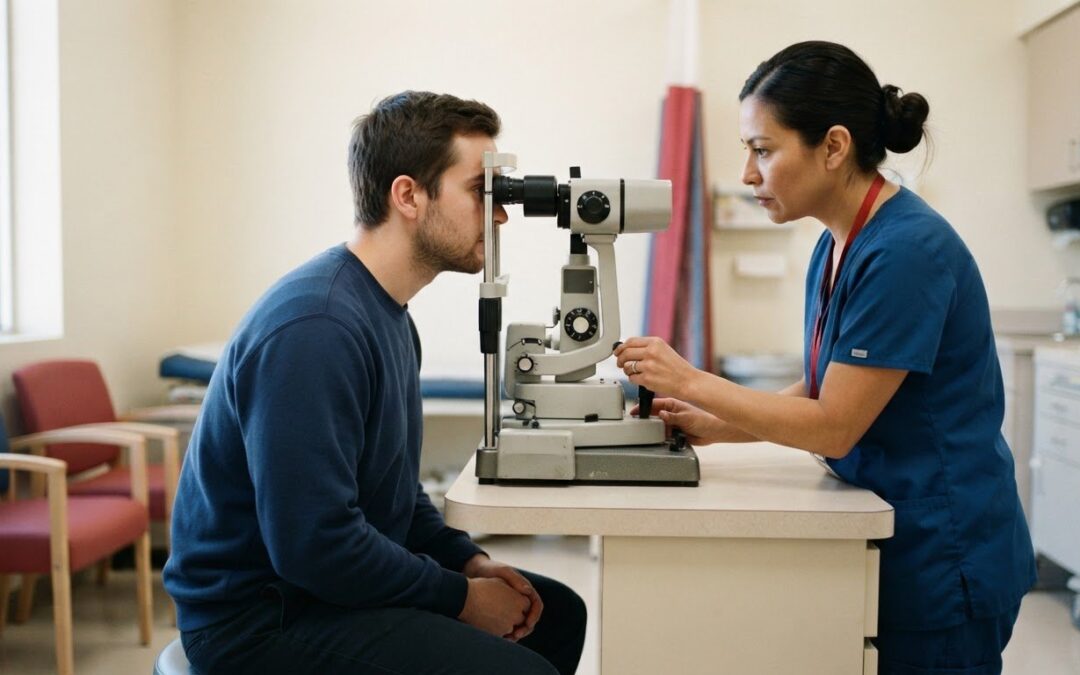
Vision and hearing checks assess senses that may matter for a specific role. An employer may request a vision evaluation for work involving detailed visual tasks, or a hearing assessment where clear communication is essential. The exam’s scope depends on the job requirements, not a single checklist for every applicant. The clinician records findings as part of the overall evaluation.
A pulmonary or respiratory function test may be included when the position’s duties make breathing capacity relevant. The clinician can assess respiratory function as part of the physical examination. This check is distinct from a routine vision or hearing screen and isn’t automatically part of every pre-employment exam. The employer’s requested tests help shape the evaluation.
Blood tests and urinalysis may also be requested. These are separate screening steps, and the requested tests depend on the employer’s instructions. If blood testing requires fasting, the typical fasting period is 8 to 12 hours. Follow the specific preparation directions provided for the appointment, since requirements can differ by test.
TB screening and immunization checks may be requested for roles with relevant workplace requirements. An employer may ask for vaccination records or a screening result as part of the pre-employment process. These checks are different: an immunization record documents vaccination, while a TB test is a screening assessment. The employer’s instructions identify which records or tests are needed.
Before the visit, review the employer’s list of requested checks and bring any relevant immunization documents. Tell the clinician if a test’s preparation instructions are unclear, especially before fasting or laboratory testing. A clinic can complete tests that are available on-site; additional testing may require another visit. A focused medical evaluation can help organize the requested checks around the role’s requirements.
Job-specific fit-for-duty exams
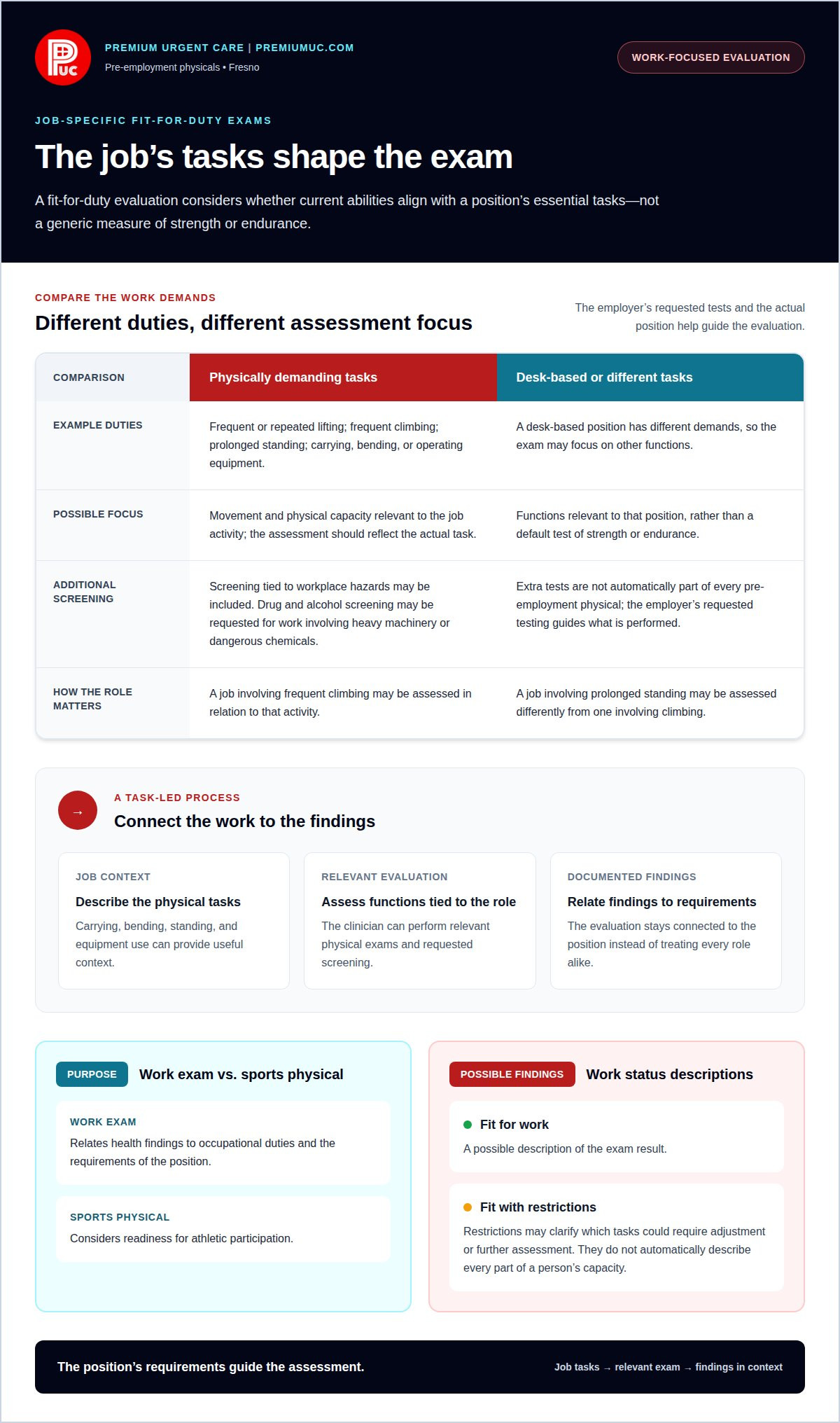
A fit-for-duty exam assesses whether a candidate’s current abilities align with essential tasks. The evaluation should reflect the actual position, not a generic measure of strength or endurance. For example, a role involving repeated lifting may require assessment of movement and physical capacity relevant to that activity. A desk-based job has different demands, so its examination may focus on other functions.
Testing can include a physical examination and additional screening tied to workplace hazards. Drug and alcohol screening may be part of exams for jobs involving heavy machinery or dangerous chemicals. These checks address specific job conditions and aren’t automatically included in every pre-employment physical. The employer’s requested testing guides which assessments are performed.
Sports and work exams serve different purposes. A sports physical considers readiness for athletic participation, while a work exam relates findings to occupational duties. A candidate seeking a role with frequent climbing, for instance, may be assessed differently from someone whose tasks involve prolonged standing. The examination’s focus follows the activity being evaluated.
Before an appointment, the process works best when the clinician has a clear description of the job’s physical tasks and requested tests. In physically demanding sectors like building and infrastructure development—undertaken by firms such as Pronamic Construction Limited—duties such as carrying, bending, standing, or operating equipment provide useful context. The clinician can perform relevant physical exams and document findings in relation to those requirements, rather than treating every role alike.
Results may describe a candidate as fit for work, or fit with restrictions when a disability limits some job functions. Restrictions can clarify which tasks may require adjustment or further assessment. They don’t automatically describe every part of a person’s capacity. A work-focused evaluation considers the specific functions involved and the examination findings, keeping the assessment tied to the position. When medical restrictions intersect with broader employment protections or social security disability evaluations in other jurisdictions, specialized legal resources like Zulmar Pimentel Advogado Previdenciário INSS e Trabalhista provide guidance on labor rights and benefits.
Medical history review
A medical history review helps interpret examination findings in the context of a candidate’s health. The clinician may ask about current treatment, medications, past injuries, and relevant conditions. For example, a previous back injury may matter for a role involving repeated lifting. Clear answers help connect the history to the actual workplace duties.
A medical history is not a complete record of every health event. The review focuses on information relevant to the requested examination and job demands. If a physical reveals a condition that needs clarification, an employer may request additional documentation from the candidate’s healthcare provider. That information can help explain how the condition relates to specific job functions.
A medical condition does not automatically determine whether someone can perform a role. Employers may consider workplace accommodations when a condition affects a candidate’s ability to complete job duties. A worker with a disability may be considered fit with restrictions if the disability limits some functions. Any hiring decision based on a medical condition must follow applicable labor and nondiscrimination requirements and relate to the job’s specific demands.
Asbestos exposure involves a distinct type of medical surveillance. OSHA regulation 1910.1001 covers medical surveillance exams for employees exposed to asbestos. This is not simply a routine hiring physical: the exposure context determines whether that occupational evaluation applies. The exam’s purpose is tied to the workplace hazard and the employee’s exposure.
To prepare for a history review, bring the employer’s forms and a current medication list. Include relevant information about treatment or prior injuries, especially when it relates to essential tasks. Clear records can help the clinician document findings accurately and identify questions that need follow-up. For a work-focused examination, schedule a work physical.
Premium Urgent Care: sports physicals and work physicals
Premium Urgent Care provides work physicals for people completing an employer-requested evaluation and sports physicals for athletic participation. A work physical can document findings relevant to the role, while a sports physical focuses on readiness for sports. Bring the employer’s instructions or required forms so the visit can address the requested exam.
If you’re unsure which type of physical your paperwork describes, review the form’s stated purpose and required assessments. Premium Urgent Care also treats acute concerns such as colds, coughs, and upper respiratory infections, as well as ear and sinus infections and urinary tract infections.
Contact Premium Urgent Care to discuss a work physical or sports physical.
Move forward with a clear plan
Use the employer’s request to understand the purpose of your appointment and keep the process focused on the role. If the form leaves you unsure about what the exam should cover, note the unclear item before the visit. A concise description of the position’s physical demands can also help keep the evaluation relevant. These steps make it easier to discuss the exam and understand what happens next.
A pre-employment physical in Fresno can be a practical step toward starting a new role. If you need a work physical, Premium Urgent Care provides this service locally in Fresno, Clovis, and Selma. The clinic also treats acute concerns, including coughs, ear or sinus problems, and urinary tract symptoms.
Contact Premium Urgent Care to discuss your next step. With a clear request and a focused appointment, you can move ahead with greater confidence.
Frequently Asked Questions
Where can I get a pre-employment physical in Fresno, CA?
For a pre-employment physical in Fresno, Premium Urgent Care provides work physicals. Bring your employer’s instructions and any forms to the appointment so the requested exam requirements are clear. If the paperwork identifies specific tests, review those details before your visit. This helps distinguish a general work physical from an evaluation with additional job-related requirements.
Do Fresno clinics offer same-day or walk-in pre-employment physicals?
Walk-in urgent care and walk-in pre-employment physicals are not necessarily the same service. Premium Urgent Care provides walk-in urgent care consultations, but that does not establish that a pre-employment physical can be completed as a walk-in. For a work physical, use the employer’s instructions to identify the required exam and bring them to the visit.
Are drug testing, TB testing, or vaccinations included in Fresno pre-employment physicals?
These tests and checks aren’t automatically part of every physical. The employer’s requested screening determines whether drug testing, a TB test, or vaccination documentation is relevant. For example, a role with a specific exposure concern may have different requirements from an office position. Review the employer’s written requirements to know which items are part of your evaluation.
What are California rules for pre-employment medical exams and disability-related questions?
In general, a medical exam tied to hiring follows a conditional job offer and relates to the position’s duties. Employers must base decisions on the job’s specific demands and follow nondiscrimination requirements. If a condition affects a job function, workplace accommodations may be considered. The EEOC states its final rule implementing the Pregnant Workers Fairness Act applies to employers with 15 or more employees.
How do I find a clinic in Fresno that accepts employer forms or specific physical exam requirements?
Start with a Fresno-area clinic that provides work physicals, then bring the employer’s form and written exam instructions to the appointment. Those documents clarify the job, requested assessments, and any reporting requirements. Premium Urgent Care provides work physicals in Fresno, Clovis, and Selma. The paperwork gives the clinician relevant context and helps focus the examination on the requested requirements.