

A minor injury or common illness often needs prompt attention, but not an emergency room. For non-emergency medical care in Fresno, urgent care centers treat non-life-threatening problems such as sprains, infections, colds, flu, minor fractures, and cuts that need stitches. Emergency rooms are intended for life-threatening conditions and serious injuries requiring immediate, specialized care.
It can be hard to decide where to go, especially when you also need to plan your visit and understand your insurance coverage. This guide explains what urgent care treats, how to prepare for a visit, and what to consider when reviewing your plan. It also explains when symptoms may require emergency care, so you can choose the right setting.
Key Takeaways
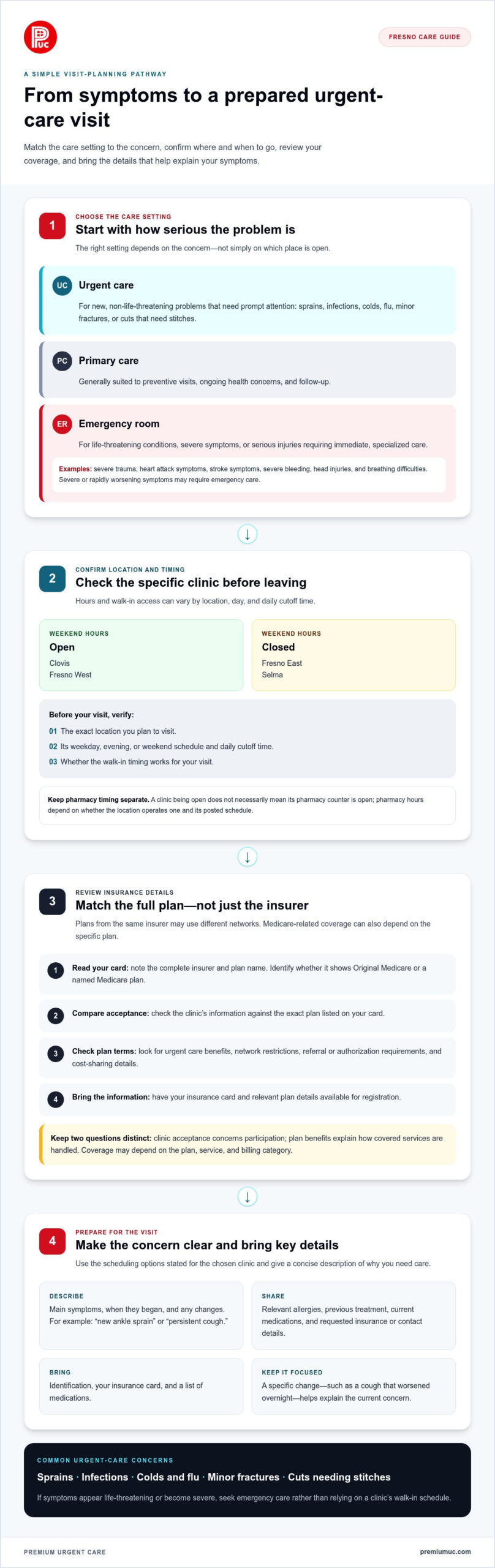
- Match the care setting to the problem: urgent care treats many non-life-threatening illnesses and minor injuries, while severe or life-threatening symptoms need emergency care.
- Use clinic locations and hours to plan where and when to seek care in Fresno.
- Learn what to consider about insurance acceptance and coverage before arranging a visit.
- Prepare for an appointment by understanding the access steps and information that can help explain your symptoms.
- For colds, coughs, upper respiratory infections, ear or sinus concerns, and urinary tract infections, learn how Premium Urgent Care may help.
Clinic hours and service area
For non-emergency medical care in Fresno, clinic schedules vary by location and day of the week. Operating hours often differ between facilities, which illustrates why checking the specific location matters before planning a visit. A clinic’s standard weekday opening time doesn’t establish its evening or weekend availability.
Walk-in access depends on the location’s hours and daily cutoff times. Before leaving, confirm which clinic you plan to visit and check its schedule. If your symptoms change or worsen, reconsider whether urgent care is still appropriate. Severe or rapidly worsening symptoms may require emergency care instead.
Choose urgent care for a new, non-life-threatening problem that needs prompt attention, such as a minor injury or infection. Primary care is generally suited to preventive visits, ongoing health concerns, and follow-up. Choose the emergency room for severe symptoms or serious injuries. According to the Centers for Medicare & Medicaid Services, an emergency medical condition can involve symptoms where delaying immediate care could seriously jeopardize health.
Emergency rooms are open 24/7, and the average emergency-room wait is 1-2 hours. Those figures don’t determine the right setting: the seriousness of the symptoms does. Severe trauma, heart attack symptoms, stroke symptoms, severe bleeding, head injuries, and breathing difficulties are examples of emergency-room concerns.
The right hours depend on the day and location. Premium Urgent Care’s Clovis and Fresno West locations are open on weekends; Fresno East and Selma are closed on weekends. Check the specific location’s schedule before you go, since hours differ across Clovis, Fresno, and Selma.
Pharmacy hours are separate from clinic hours. An on-site pharmacy’s schedule depends on whether the location operates one and on its own posted hours. A clinic being open does not necessarily mean its pharmacy counter is open. Keep medication questions and prescription pickup plans separate from your clinic visit timing.
- Identify the exact Fresno location before setting out.
- Compare its weekday, evening, and weekend hours with your intended visit.
- For pharmacy needs, distinguish pharmacy hours from clinic hours.
These steps help you match the care setting and timing to your immediate needs. If symptoms appear life-threatening, seek emergency care rather than relying on a clinic’s walk-in schedule.
Insurance acceptance
Insurance plan names and Medicare participation matter when arranging non-emergency care. Compare the exact plan listed on your insurance card with the clinic’s accepted-plan information before your visit.
Accepted Insurance Plans
Accepted plans are identified by insurer and specific plan name, not just a familiar insurance brand. Two cards from the same insurer may show different networks. Match the full plan name on your card with the clinic’s published acceptance information instead of assuming every product from that insurer is accepted.
For a visit involving a sprain or infection, review your plan’s terms for urgent care. Check for referral requirements, network restrictions, and cost-sharing details in your coverage documents. Have your insurance card ready, including member and group information, to help identify the plan accurately.
Medicare Acceptance
Medicare acceptance depends on the clinic’s participation and the specific coverage shown on your card. The word “Medicare” alone may not identify your plan. Read the insurer and plan details, then compare them with the clinic’s Medicare information. This distinction matters when a Medicare-related plan uses a separate network.
Before arranging care, identify whether your card shows Original Medicare or a named Medicare plan. Review the plan documents for urgent care benefits and any network or referral terms. Bring your card and a list of current medications to support accurate registration and billing information.
Use this practical sequence to organize insurance details:
- Read the complete insurer and plan name on your current card.
- Locate urgent care coverage and network terms in your plan materials.
- Note any referral, authorization, or cost-sharing instructions stated there.
- Bring the card and relevant plan information to the clinic.
Coverage can depend on the specific plan, service, and billing category. A consultation for urinary symptoms, for example, may be treated differently from a procedure under your plan. Review benefits using the service description and plan documents, rather than relying on the insurer’s name alone.
Insurance acceptance and payment responsibility are related, but they are not identical questions. A plan’s acceptance information concerns participation; its benefit terms explain how covered services are handled. Keep those questions distinct when reviewing your coverage. For care involving infections or minor injuries, urgent care consultations are one service to consider.
Appointments and patient access
When arranging a visit, use the clinic’s stated scheduling options and describe why you need care. A clear summary, such as “new ankle sprain” or “persistent cough,” helps the care team understand your concern.
Start by following these steps:
- Choose the clinic location and appointment method shown for that site.
- Share your main symptoms, when they began, and any changes.
- Provide insurance and contact details requested during registration.
- Bring identification, your insurance card, and a medication list.
Share relevant allergies, previous treatment, and medications with the care team. For example, saying that a cough worsened overnight is more useful than reporting only that you feel unwell. Keep your description concise and focused on the current concern.
MyChart supports appointment scheduling for healthcare organizations that use the platform. Sign in to the organization’s MyChart account, open the appointment section, and follow the options shown. Available visit types and scheduling steps are set by that organization. Use the appointment details in your account to confirm the location, time, and instructions.
Wait times can change with patient arrivals, clinical urgency, staffing, and the care each visit requires. A scheduled appointment helps organize access but does not guarantee an exact evaluation time. Walk-in visits follow the clinic’s intake process, and patients with more urgent needs may require prompt attention. Bring your symptom notes and registration details to help the visit get started.
To access telehealth or nurse advice for non-emergency care in Fresno, use the healthcare organization’s patient portal or listed phone line. Choose the telehealth or nurse-advice option shown, then describe your symptoms and ask how to proceed. Share your location, current medicines, and any recent changes. For breathing difficulty or other potentially life-threatening symptoms, seek emergency care rather than relying on a remote appointment.
A useful visit starts with clear information. Before seeking care, note your main concern, when symptoms began, and any questions you have. If you’re coming in for an infection or minor injury, identify the problem that needs attention first. This helps keep the discussion focused and clarifies next steps.
Premium Urgent Care at 2021 Herndon Ave in Clovis is listed as open Monday through Saturday from 10am – 6:30pm and Sunday from 9am to 3pm. Confirm the clinic’s listed hours when planning a visit, and use the appointment or intake instructions provided by the clinic.
Clinic addresses
Use the full street address, suite number, and city to select the correct clinic. Fresno-area listings include a location at 6643 N Milburn Ave Suite 104 and another at 2021 Herndon Ave Suite 101 in Clovis. The city and suite details help distinguish nearby locations when planning a visit.
The Fresno location at 6643 N Milburn Ave Suite 104 is listed with weekday hours from 9:00 a.m. to 7:00 p.m. The Clovis location at 2021 Herndon Ave Suite 101 is listed with weekday hours from 9:00 a.m. to 6:30 p.m. These are separate locations with different schedules, so use the address and hours for the site you intend to visit.
Before leaving, follow a simple location check:
- Match the street number and street name to the intended clinic.
- Check the suite number, especially for 6643 N Milburn Ave Suite 104.
- Confirm the city; Herndon Ave Suite 101 is in Clovis.
- Review the clinic’s current schedule for your planned visit.
Clinic phone numbers and websites are useful for confirming directions, appointment details, and operating information. Use the clinic’s official location page or directory to identify the correct phone number for the specific address. A general clinic number may serve more than one site, so compare the location name and street address before calling.
For website searches, enter the exact address rather than only “urgent care Fresno.” This can help distinguish a Fresno listing from a Clovis location or another result with a similar name. Check that the page’s address matches your destination before using its directions or contact details. Do not rely on a saved map pin if its street or suite information differs.
Allow time to locate the entrance and suite after arriving. For example, a navigation result may end at the street address, while the clinic’s suite number identifies the destination within the building. Keep the address accessible on your phone or written appointment information. If you call, state the location you plan to visit and the reason for your call.
Confirming the location before you leave can help avoid a wrong turn or a delayed visit. Check the specific address and schedule for the clinic you plan to visit in Clovis, Fresno, or Selma. For symptoms requiring emergency attention, seek emergency care rather than travelling to a clinic.
Illness and minor-injury treatment
Urgent care addresses many acute problems that need attention but aren’t life-threatening. Examples include colds, flu, infections, sprains, minor fractures, and cuts requiring stitches. The right setting depends on how severe the symptoms are and whether they’re worsening.
For an illness, describe the main symptom, when it began, and how it has changed. A cough that has become more disruptive, for example, gives the clinician a clearer starting point than “I feel sick.” Mention related concerns, such as a sore throat or fever, and any medicines already taken. These details help focus the evaluation.
Urgent care can assess and treat upper respiratory infections, flu- and COVID-related illness, ear concerns, and urinary symptoms. For a sore throat, explain what you’re feeling and how it has changed. For urinary symptoms, say what you’re experiencing and when it began. Clear details support a more useful clinical conversation.
Minor injuries vary in type and the care they need. Urgent care treats problems such as sprains, minor fractures, and cuts requiring stitches. Cuts, wounds, and minor burns may also need clinical attention. Describe how the injury happened, where it hurts, and whether it has changed your movement or usual activities.
Share these details during the visit:
- The main illness or injury and when it began.
- Changes since onset, including worsening symptoms.
- Medicines taken and relevant allergies.
- For an injury, how it occurred and which area is affected.
Those details help the care team understand what needs attention, whether it’s an ankle sprain or a cut that needs wound assessment. Don’t downplay symptoms that have changed; describe the change clearly.
Some conditions need emergency care rather than an urgent care visit. Severe trauma, severe bleeding, head injuries, breathing difficulties, and signs of heart attack or stroke are emergency-room concerns. Emergency rooms are intended for life-threatening conditions and serious injuries requiring immediate, specialized care. If symptoms suggest an emergency, seek emergency care instead of waiting for a clinic visit.
Urgent care can address non-life-threatening illnesses and minor injuries, while emergency services handle severe or life-threatening problems. For a new cough, sprain, or cut, describe your symptoms and how the injury happened when seeking care. This gives the clinician a clear starting point for evaluating the concern and determining next steps.
Premium Urgent Care: Colds, cough, and upper respiratory infections
Premium Urgent Care treats colds, coughs, and upper respiratory infections. If congestion, coughing, or throat discomfort needs clinical attention, an urgent care consultation can assess the concern and guide next steps. The clinic also provides care for ear and sinus infections and urinary tract infections.
Before your visit, note when symptoms began, what has changed, and any related concerns. For example, mention whether a cough comes with sinus discomfort or whether urinary symptoms are new. This helps focus the consultation on why you’re seeking care. For severe or life-threatening symptoms, seek emergency care instead.
For colds, coughs, or upper respiratory symptoms, visit Premium Urgent Care in Fresno, Clovis, or Selma for an urgent care consultation.
Take the Next Step Toward Care
Choosing non-emergency medical care in Fresno starts with identifying what needs attention and preparing to describe it clearly. Before your visit, note your main symptoms, when they began, and what has changed. This can help keep the conversation focused on your immediate needs.
Premium Urgent Care treats colds, coughs, and upper respiratory infections, as well as ear and sinus infections and urinary tract infections. These common concerns can disrupt daily routines and deserve clinical attention. For severe or life-threatening symptoms, seek emergency care.
If you’re ready to discuss a non-emergency concern, contact Premium Urgent Care to take the next step. A clear account of your symptoms can help you prepare for the conversation and make your care needs easier to explain. Move forward with a plan that fits the concern, and seek the appropriate care for your health.
Frequently Asked Questions
What non-emergency medical care options are available in Fresno, California?
In Fresno, urgent care can address acute illnesses and minor injuries, while primary care is generally suited to routine and ongoing health needs. Premium Urgent Care treats coughs, upper respiratory infections, ear and sinus infections, urinary tract infections, sprains, and minor wounds. A new cough or mild sprain may fit urgent care; severe or life-threatening problems need emergency care.
Where are urgent care clinics in Fresno and what are their hours?
Fresno-West (Milburn & Herndon), 6643 N. Milburn Ave., Fresno, CA 93722, is open Mon-Fri 9:00 am – 5:30 pm (last walk-in 5:00 pm); Sat 9:00 am – 2:30 pm (last walk-in 2:00 pm); Sun 9:00 am – 2:30 pm (last walk-in 2:30 pm). Fresno-East (Champlain & Perrin), 1069 E. Champlain Drive, Fresno, CA 93720, is closed for lunch daily 1:00 pm – 2:00 pm; Mon-Fri 9:00 am – 4:15 pm (last walk-in 4:15 pm); Sat CLOSED; Sun CLOSED.
Which Fresno clinics offer same-day or walk-in appointments?
Premium Urgent Care provides walk-in consultations at its Fresno locations. Plan around the hours and last-walk-in time for the specific location. Online options include “Online Check-In – Click Here” and “Complete Forms at Home – CLICK.” These tools support check-in and form completion but do not guarantee an appointment time or same-day availability.
What is the average cost of an urgent care visit in Fresno without insurance?
There isn’t a single visit cost that applies to every urgent care case. The amount depends on the evaluation and care provided, such as whether the visit concerns an illness, injury, or minor procedure. The clinic gives pricing after a quote request. To understand the expected charge, describe the reason for the visit and any treatment or procedure being considered.
Which Fresno urgent care clinics accept Medi-Cal, Medicare, or major insurance plans?
Insurance acceptance depends on the clinic and the specific insurance product, not just the insurer’s name. Medi-Cal coverage may involve a specific managed plan, while Medicare coverage depends on the arrangement shown on your card. Compare your full plan name and network terms with the clinic’s participation information, and review benefits for the service you need.
What services do Fresno urgent care clinics provide, such as X-rays, lab tests, and vaccinations?
Urgent care services vary by clinic. Premium Urgent Care provides consultations for acute illnesses and minor injuries, including respiratory infections, ear and sinus infections, urinary tract infections, sprains, and minor wounds. The clinic also sutures lacerations and performs incision and drainage of abscesses. Don’t assume X-rays, lab tests, or vaccinations are included with every urgent care visit.